How to use the baby eye color calculator
- Select the father's eye color from the first dropdown.
- Select the mother's eye color from the second dropdown.
- Add grandparent colors if you know them. Each one sharpens the estimate by revealing recessive genes the parents carry but don't show.
- Press Calculate to see a percentage for every possible eye color, ranked most to least likely.
- Read the "What this means" summary, then use the share row to send the eye color prediction to a partner or family group chat.
If an eye reads as a brown-green mix, choose hazel. If you're torn between two shades, pick the darker one — people tend to describe their own eyes lighter than they measure.
How baby eye color is inherited
Eye color comes from melanin in the iris. Brown eyes have abundant melanin. Blue eyes have very little — their color isn't pigment at all, but light scattering off the iris fibers, the same effect that makes the sky look blue. Green and hazel sit in between.
Two genes do most of the work. OCA2 regulates melanin production inside iris cells. HERC2, next to it on chromosome 15, holds a regulatory switch for OCA2 — a single variant there (rs12913832) is the main genetic switch between brown and blue eyes in people of European descent.[1] At least sixteen additional genes contribute smaller effects, which is why eye color sits on a spectrum rather than in tidy boxes and why a simple baby eye color chart by parents can only ever be an approximation of true polygenic inheritance.[2]
Why grandparents matter
Recessive alleles can pass through a generation without showing. Two brown-eyed parents from all-brown-eyed families have a different genetic profile from two brown-eyed parents who each had a blue-eyed mother — even though both couples look identical. In the second case, the odds of a blue-eyed child rise substantially. This is the same logic behind a Punnett square eye color diagram, which maps how dominant and recessive eye color genes combine across a family tree.
Eye color probability chart
Approximate probabilities for common parent combinations — general tendencies, not fixed outcomes.
| Parent 1 | Parent 2 | Brown | Blue | Green | Hazel | Gray/Amber |
|---|---|---|---|---|---|---|
| Brown | Brown | 75% | 6% | 7% | 8% | 4% |
| Brown | Blue | 50% | 31% | 7% | 8% | 4% |
| Brown | Green | 50% | 8% | 30% | 8% | 4% |
| Brown | Hazel | 50% | 8% | 8% | 30% | 4% |
| Blue | Blue | 1% | 81% | 7% | 7% | 4% |
| Blue | Green | 1% | 40% | 40% | 8% | 11% |
| Blue | Hazel | 7% | 31% | 30% | 25% | 7% |
| Green | Green | 1% | 25% | 61% | 7% | 6% |
| Green | Hazel | 7% | 20% | 30% | 36% | 7% |
| Hazel | Hazel | 8% | 15% | 25% | 45% | 7% |
The six eye colors explained
When does a baby's eye color settle?
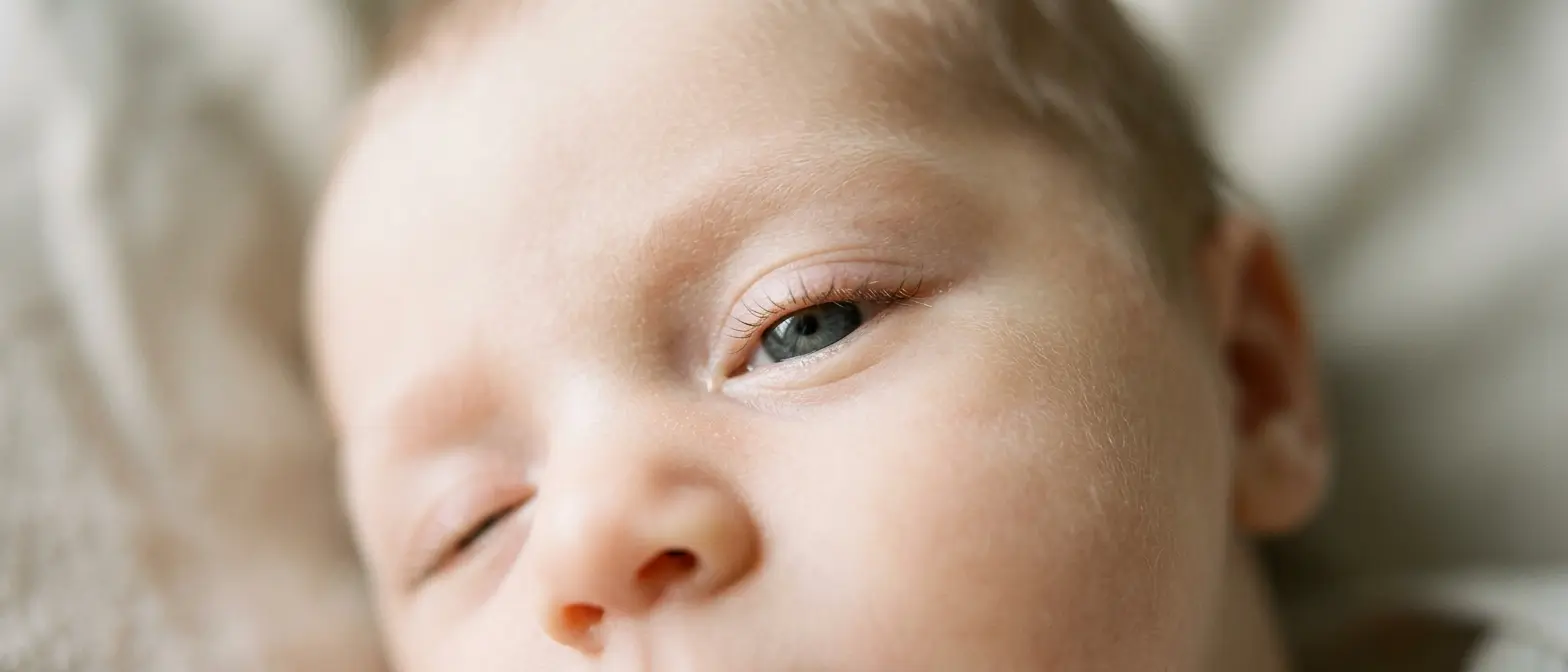
Many babies, particularly of European descent, are born with grayish or slate-blue eyes regardless of their eventual color. Melanin production in the iris isn't complete at birth and increases with light exposure over the following months. Most children settle into their permanent color by their first birthday, though some continue shifting until around age three — one reason a newborn eye color chart is far less reliable than a chart based on parents' adult eye color.
Genetics terms related to eye color prediction
- Allele
- One version of a gene. A person carries two alleles for each pigmentation gene, one from each parent.
- Dominant / recessive
- A dominant allele (like brown) shows up even when paired with a different allele; a recessive allele (like blue) only shows up when paired with another recessive allele.
- Genotype vs. phenotype
- Genotype is the actual genetic makeup a person carries; phenotype is what's visibly expressed — like eye color. Two people can share a phenotype but carry different genotypes.
- Carrier
- Someone who carries a recessive allele without showing it — a brown-eyed parent can be a hidden carrier of the blue-eye allele.
- Polygenic trait
- A trait, like eye color, shaped by many genes acting together rather than a single gene switch.
- Heterochromia
- A rare condition where a person's two eyes are different colors, caused by uneven melanin distribution rather than inheritance alone.
Sources
- National Library of Medicine, MedlinePlus Genetics — Is eye color determined by genetics?
- Sturm et al., American Journal of Human Genetics (NIH/PMC) — A Single SNP in HERC2 Determines Human Blue-Brown Eye Color
Frequently asked questions
It's uncommon but genuinely possible. If each parent carries a brown-eye allele that's suppressed in them, a child inheriting it from both can express brown.
Yes, and it's more common than the reverse. If both parents carry a recessive blue allele — often visible in a blue-eyed grandparent — roughly one in four of their children may have blue eyes.
Among standard colors, green is the rarest at about 2 percent of people worldwide. Gray and amber are also uncommon.
The calculator produces a result from the parents alone. Grandparent data improves accuracy by revealing recessive genes, but it isn't required.
No. Everything runs in your browser — nothing is sent to a server, saved, or linked to you.
It reflects established inheritance patterns but isn't a genetic test. For questions about inherited eye conditions, consult an ophthalmologist or genetic counselor.